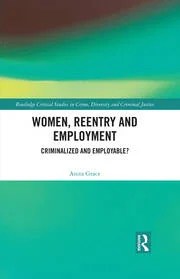
Women, Reentry and Employment: Criminalized and Employable? is the result of my doctoral research exploring the barriers to employment faced by women leaving prison.
After spending more than a year meeting with formerly incarcerated women and service providers, I was able to map out the landscape of employability supports available to reentering women and the ‘steps to employment’ they were directed to follow.
I was fascinated to discover that women who experience incarceration are viewed in two fundamentally incompatible ways:
- On one hand, they are treated as broken, irrevocably damaged, ‘criminalized women’. Their experiences of trauma and marginalization are interpreted as rendering them incapable of acting in their own best interests.
- On the other, they are expected to be immediately employable and employment-focused. They are directed to be confident, future-oriented, and actively engaged in their own socio-economic inclusion.
How do reentering women experience, inhabit, and resist these incompatibilities?
My book offers a timely contribution to Canada’s reintegration scholarship that has not adequately explored the unique needs and perspectives of women. It summarizes rich, empirical-data and extensive research on women’s employment, employability and reintegration. It will be of great interest to students and scholars of Criminology, Penology, and Women’s Studies.
Securing research funding
I was grateful to be successful in receiving funding from Carleton University, Ontario’s Graduate Scholarships, and Canada’s Social Sciences and Humanities and Research Council. This funding supported my field research across southeastern urban Ontario.
As as SSHRC recipient, I competed in their annual Storytellers competition and was named one of the top 25 finalists in 2019. This allowed me the opportunity to share my research more broadly and participate in workshops to hone my skills in sharing key findings and insights.
 Anita Grace
Leave a comment