I’ve been working on a research project that examines factors and decision points contributing to police involvement with persons in crises. My aim is to advance evidence-based efforts to improve safe and effective responses to mental health crises.
I’ve prepared some preliminary findings here in advance of presenting a poster at the Building Bridges Evidence-Based Policing Conference. (If you saw my poster and are looking for my references, you’ll find them below.)
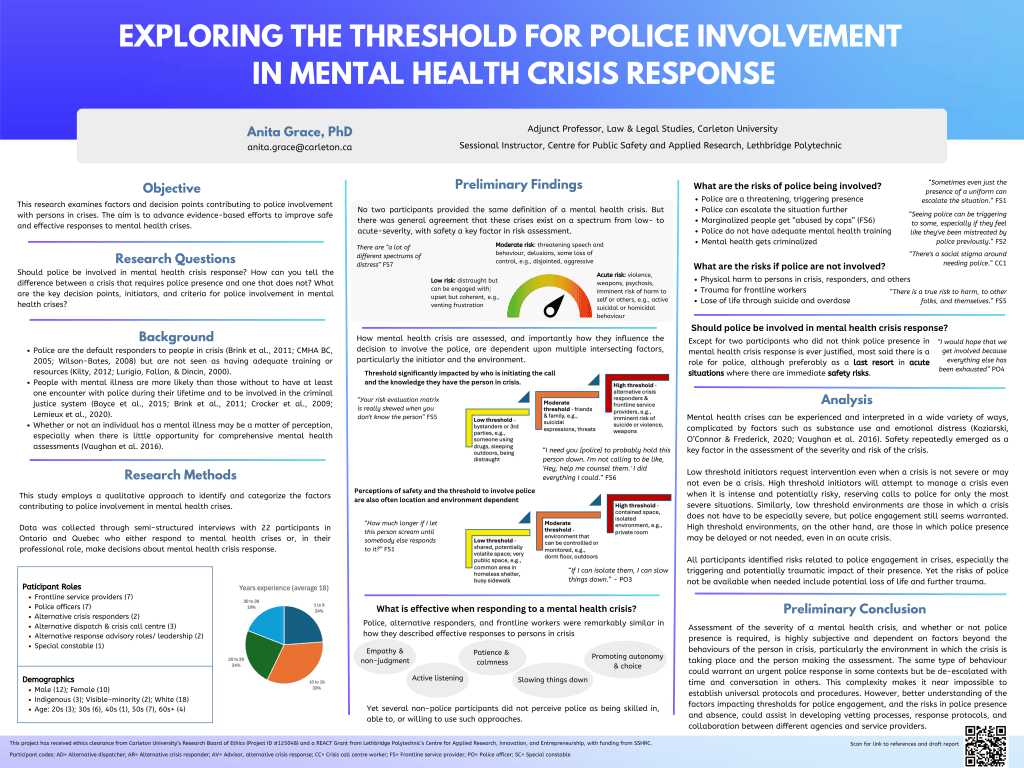
My research questions
- Should police be involved in mental health crisis response?
- How can you tell the difference between a crisis that requires police presence and one that does not?
- What are the key decision points, initiators, and criteria for police involvement in mental health crises?
My research process
Thus far, I’ve interviewed 22 people in Ontario and Quebec who either respond to mental health crises or, in their professional role, make decisions about mental health crisis response. This includes police officers, alternative crisis responders, frontline service providers, and crisis call takers.
Here’s what I’m learning…
Mental health crises exist on a spectrum
No two people have provided the same definition of a mental health crisis! This likely contributes to the challenges in reaching agreement about an appropriate response.
Still, there was general agreement that mental health crises exist on a spectrum from low- to acute-severity. Safety is key factor in risk assessment. But assessment is highly subjective and dependent on things beyond the behaviours of the person in crisis. The environment in which the crisis is taking place and the initiator, or person making the assessment, seem to be key factors in how severity and risk will be determined – and whether or not police should be involved.
“I would go back to safety whether safety for that person or safety to others. I think that’s kind of the main thing that I would think about when I think of crisis.” FS2
Low threshold initiators request intervention even when a crisis is not severe or may not even be a crisis – the most common example was a bystander or third-party who sees something that causes concern and initiates an emergency response. This could be someone sleeping outside or showing distress in public.
“They don’t necessarily have a crisis going on, but the person on the street who saw them viewed it as if that was a crisis” AR1
High threshold initiators, on the other hand, will attempt to manage a crisis even when it is intense and potentially risky, reserving calls to police for only the most extreme situations. Experienced frontline service providers or alternative crisis responders would be examples of high threshold initiators – they will use their skills and training to manage a situation to the full extent possible and often only involve the police as a last resort.
“I need you [police] to probably hold this person down. I’m not calling to be like, ‘Hey, help me counsel them.’ I did everything I could.” FS6
Similarly, low threshold environments are those in which a crisis does not have to be especially severe, but police engagement still seems warranted. An example could be a shared, potentially volatile space like the crowded common area in a homeless shelter.
“How much longer if I let this person scream until somebody else responds to it?” FS1
High threshold environments are those in which police presence may be delayed or not needed, even in an acute crisis. Examples of this are contained, safe spaces where the person in crisis is not a threat to others.
“Somebody was really ill and really not in control, but they stayed in their room. And I was able to just sit here until they were quiet.” FS4
In other words, the same type of behaviour could warrant an urgent police response in some contexts but be de-escalated with time and conversation in others. This complexity makes it near impossible to establish universal protocols and procedures.
There are risks to police presence, and absence
Most participants view police involvement as risky for several reasons, including:
- Police are a threatening, triggering presence
- Police can escalate the situation further
- Marginalized people get “abused by cops” (FS6)
- Police do not have adequate mental health training
- Mental health gets criminalized
“Sometimes even just the presence of a uniform can escalate the situation.” FS1
But they also identified the risks of police not being present when they are needed.
- Physical harm to persons in crisis, responders, and others
- Trauma for frontline workers
- Lose of life through suicide and overdose
“There is a true risk to harm, to other folks and themselves” FS5
Conclusion
Except for two participants who did not think police presence in mental health crisis response is ever justified, most said there is a role for police, although preferably as a last resort in acute situations where there are immediate safety risks. But my research is showing that determination of which acute situations and the extent of the safety risks is dependent on multiple, over-lapping factors – especially the environment and the person making the assessment.
There is never going to be an easy answer or a one-size-fits-all solution.
But better understanding of the factors impacting thresholds for police engagement, and the risks in police presence and absence, could assist in developing vetting processes, response protocols, and collaboration between different agencies and service providers.
As I continue to develop my analysis of the research conducted thus far, and speak with additional participants who have insights into this topic, I hope to develop further conclusions that will be applicable to police services, alternative crisis responders, and other interest holders.
Please reach out if you have comments, or questions.
References
Boyce, Jillian, Cristine Rotenberg, and Maisie Karam. 2015. “Mental Health and Contact with Police in Canada, 2012.” Juristat: Canadian Centre for Justice Statistics. Ottawa.
Brink, Johann, James Livingston, Sarah Desmarais, Erin Michalak, Simon Verdun-Jones, and Camia Weaver. 2011. “A Study of How People with Mental Illness Perceive and Interact with the Police.” Calgary.
CMHA_BC. 2005. “Police and Mental Illness : Increased Interactions.” Vancouver.
Crocker, Anne G., Kathleen Hartford, and Lisa Heslop. 2009. “Gender Differences in Police Encounters among Persons with and without Serious Mental Illness.” Psychiatric Services 60 (1): 86–93.
Kilty, Jennifer. 2012. “‘It’s like They Don’t Want You to Get Better’: Psy Control of Women in the Carceral Context.” Feminism and Psychology 22 (2): 162–82. Lurigio, Fallon, & Dincin, 2000
Koziarski, Jacek, Christopher O’Connor, and Tyler Frederick. 2020. “Policing Mental Health: The Composition and Perceived Challenges of Co-Response Teams and Crisis Intervention Teams in the Canadian Context.” Police Practice and Research 22 (1): 1–19.
Vaughan, Adam D., Ashley N. Hewitt, Martin A. Andresen, and Patricia L. Brantingham. 2016. “Exploring the Role of the Environmental Context in the Spatial Distribution of Calls-for-Service Associated with Emotionally Disturbed Persons.” Policing 10 (2): 121–33.
Wilson-Bates, Fiona. 2008. “Lost in Transition: How a Lack of Capacity in the Mental Health System Is Failing Vancouver’s Mentally Ill and Draining Police Resources.” Vancouver Police Board. Vancouver.
Note: This project has received ethics clearance from Carleton University’s Research Board of Ethics (Project ID #125048) and a REACT Grant from Lethbridge Polytechnic’s Centre for Applied Research, Innovation, and Entrepreneurship, with funding from SSHRC.


Leave a comment